
2020-present
GOAT Gripper
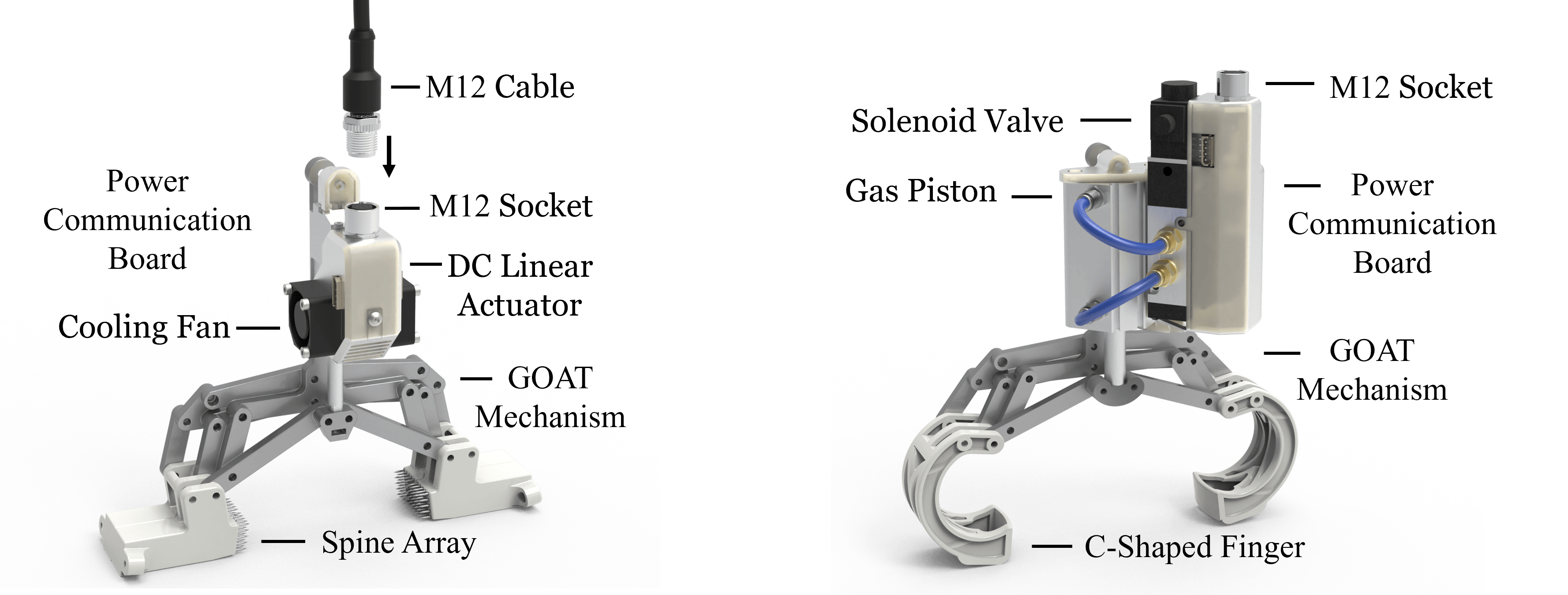
GOAT is a rigid, underactuated gripper designed for the uncertainty of free-climbing: irregular holds, imperfect toe placement, and contacts that rarely arrive on the gripper's centerline.
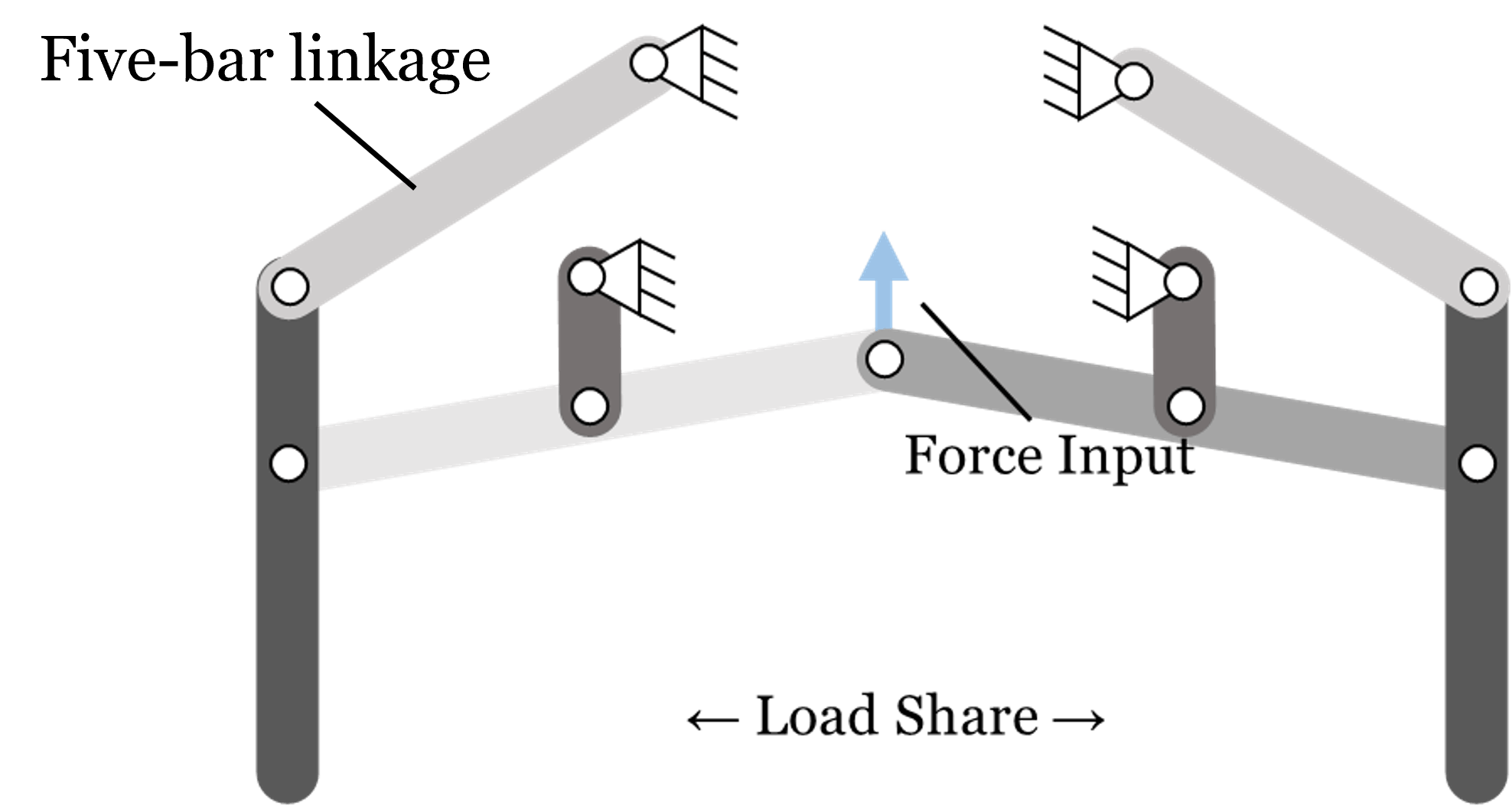
Its whippletree mechanism adds a passive degree of freedom, mechanically balancing the fingers around an object while a single input closes the gripper. The original design was optimized against both kinematic coverage and grasping force, then developed into spine-enhanced and pneumatic C-GOAT variants for SCALER.
Research focus
- Published at IEEE/RSJ IROS, 2021
- Mechanically adaptive whippletree linkage
- Multi-objective mechanism optimization
- Spine and dry-adhesive fingertips
- Seven grasping modes with C-GOAT
Project story
Images and demonstrations
6 media items
01 / Mechanical intelligence
The optimized linkage and the passive adaptation visible in the first prototype.
The dc-actuated gripper uses spine arrays for rough terrain; the pneumatic C-GOAT uses curved dry-adhesive fingers for fast, multi-modal grasping.
 01
01Whippletree mechanism
A single force input is distributed through the linkage while passive motion lets the fingertips settle around off-axis geometry.
Documentation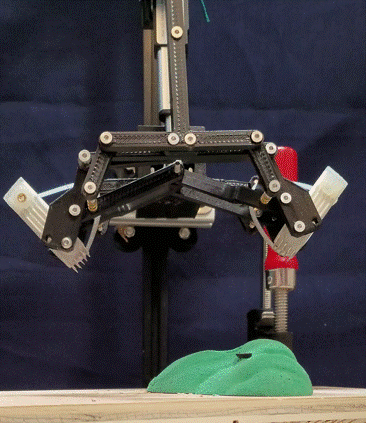 02
02Prototype open above a climbing hold
Documentation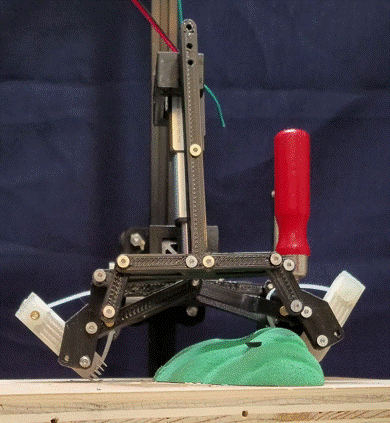 03
03Prototype adapting to an irregular hold
The linkage passively balances after the first fingertip contacts the off-center object.
Documentation02 / On the wall
The gripper becomes part of SCALER's whole-body loco-grasping system.
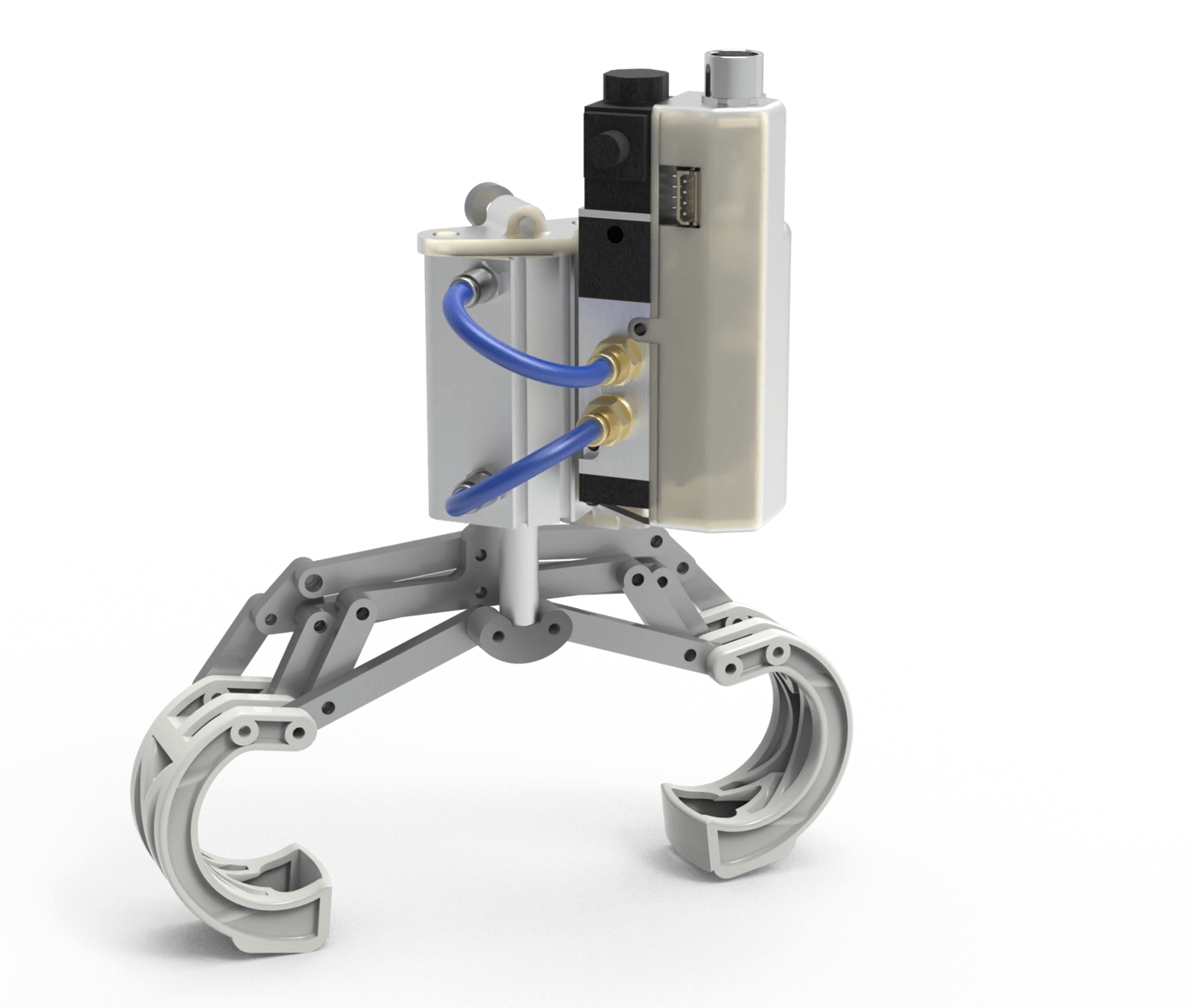
A high-pressure pneumatic actuator trades sensing and payload simplicity for substantially faster grasping.
- C-shaped fingers
- Dry-adhesive contact surface
Vertical climbing under payload
Spine-enhanced GOAT grippers support SCALER during a vertical climb with a 3.4 kg payload.
Motion study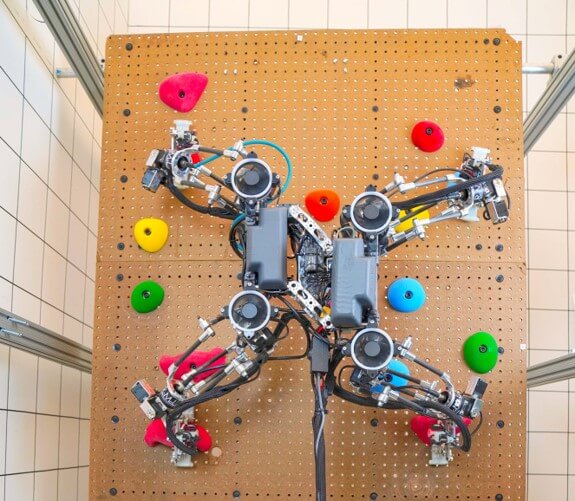
Robot platform
Built into SCALER
GOAT supplies the adaptable contact; SCALER couples it to articulated limbs, a shifting torso, force control, and climbing gaits.
Explore the SCALER projectPublications & related research
GOAT gripper paper (IROS 2021) →SCALER paper (IEEE T-RO 2025) →